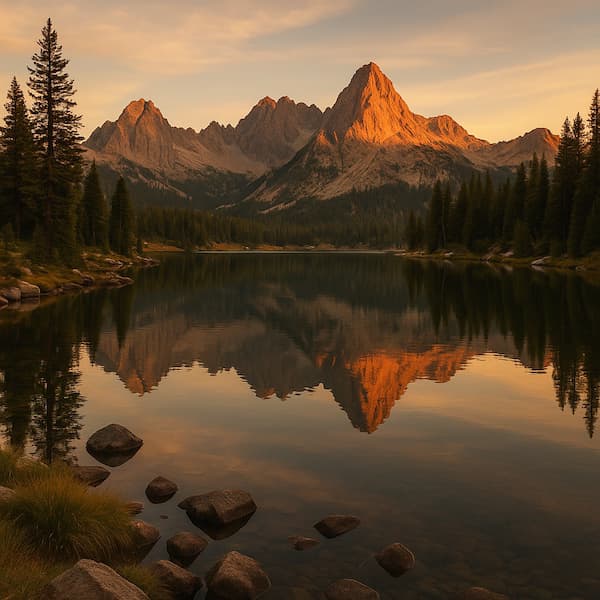
I classify the landscape before moving pieces
Nature puzzles often look calm as complete photographs, but that calm can hide difficult regions. A lake may contain the same colours as the sky. A forest may repeat hundreds of small green marks. A mountain can fade into cloud without a sharp boundary. Before I move a piece, I spend a short moment identifying the visual systems in the picture.
I ask where the horizon sits, which regions have hard edges, where the light comes from, and which textures repeat. I also look for one or two landmarks that could anchor the board: a waterfall, a path, a bright flower, a dark ridge, or a tree trunk that crosses several rows.
This is not wasted time. A useful first reading prevents me from making one enormous pile called "green" and then searching it repeatedly.
I start with boundaries, not colours
Colour is an obvious sorting tool, but a boundary usually carries more location information. A blue piece could belong almost anywhere in a sky. A piece showing blue sky meeting a dark mountain has a much narrower range of possible positions.
In Mountain Lake, I look for the line where land meets water and for any reflected version of that line below it. Reflections can repeat the shape of the landscape while reversing its direction. I keep reflected pieces separate by checking whether details appear crisp or softened by the water.
In Country Roads, the road is a structural guide. Its edges converge as they move toward the distance, so their angle tells me roughly how high or low a fragment belongs. A road piece is not merely grey or brown; it contains perspective.
I make small groups for horizon transitions, water edges, paths, prominent trunks, and rock outlines. Those groups are more useful than broad colour piles because each already describes a relationship between two regions.
I treat the sky as a gradient with direction
Large skies are difficult when I describe them only as blue. I instead read the direction of the gradient. Is the colour paler near the horizon? Does it become warmer toward a sunset? Are clouds moving diagonally, horizontally, or vertically through the frame?
For a clear sky, I compare brightness and saturation. Two fragments may both be blue, but one can be slightly greyer, lighter, or closer to cyan. I keep them in a loose order rather than a pile, placing darker fragments at one side and lighter fragments at the other.
Northern Lights requires a different approach. The bright bands have curvature and direction, while the darker gaps between them help define their shape. I assemble the strongest colour transitions first. Nearly black fragments wait until the neighbouring sky or horizon gives them context.
Clouds are useful when they have an identifiable edge. Soft cloud interiors are less decisive, so I avoid forcing them early. A fragment that contains both cloud and clear sky is usually more valuable than one filled entirely with white.
I divide foliage by scale and light
A forest is not one green texture. Leaves near the camera are larger and more distinct. Distant foliage compresses into smaller marks with lower contrast. Sunlit leaves lean toward yellow, while shaded leaves may move toward blue-green or near-black.
In Jungle Canopy, I sort by scale first, then light. Large leaf edges form one group, small distant texture another, and the deepest shadow a third. I also watch the direction of stems and branches. A diagonal branch can connect several otherwise similar fragments.
Autumn Forest offers more colour separation, but orange alone is not a position. I distinguish bright leaves, dark leaf clusters, trunks, ground cover, and open gaps. Tree trunks are especially helpful because they create long vertical lines that cross changing backgrounds.
When two foliage fragments appear interchangeable, I inspect their negative space. The small patch of sky or shadow between leaves can be more distinctive than the leaves themselves.
I use water movement as a pattern
Water changes according to its setting. A calm lake reflects large shapes and tends to produce horizontal transitions. Ocean waves contain repeated curves, foam edges, and alternating light and shadow. A waterfall creates a strong vertical flow surrounded by darker stationary material.
For Ocean Waves, I separate foam from unbroken water and compare the direction of each crest. I avoid joining pieces merely because they contain the same shade of blue. The angle of a wave and the thickness of its white edge carry better evidence.
For Majestic Waterfall, the bright cascade is the main spine. I build it from the strongest white-against-rock boundaries, then connect moss, forest, and shadow around it. White water can lose detail, so I use its outer contour before attempting the centre.
Diving combines water colour with submerged forms. I look for bubbles, limbs, equipment, or changes in light direction. Those landmarks stop the scene from becoming a single blue field.
I read mountains and rock through layers
Rock fragments often share muted colours, but their cracks and layers have direction. In Canyon, I compare horizontal geological bands, vertical breaks, illuminated faces, and shadowed recesses. A band that continues through several pieces can become a reliable local section.
Mountains also reveal depth through contrast. The nearest ridge is normally darker and sharper than distant ridges affected by haze. In Whisper Mountain, I separate foreground texture from the softer background before trying to connect similar grey pieces.
I do not assume every dark fragment belongs at the bottom. A shadowed cliff can sit high in the frame, while a reflective foreground can be bright. The complete composition, not a simple light-to-dark rule, decides position.
I leave low-information pieces until the board can answer them
Some fragments contain no landmark, boundary, or strong texture. They may show only open sky, deep shadow, or a repeated patch of leaves. I do not treat those pieces as a failure of observation. They are late-stage pieces.
Every completed neighbouring region reduces uncertainty. A blue fragment with twenty plausible positions early in the solve may have only one empty position near the end. Delaying it is an efficient decision.
The hint is most useful when a low-information region has stopped progress completely. I prefer to use it after completing the identifiable structure, because then the help resolves a genuine ambiguity instead of replacing an observation I could have made.
My nature-puzzle checklist
Before I begin, I ask:
- Where is the horizon, and is it reflected?
- Which boundaries connect two different textures?
- Does the sky gradient have a clear direction?
- Can I separate foliage by scale, light, and branch direction?
- Does water move horizontally, vertically, or in curves?
- Which rock layers or ridges reveal depth?
- Which pieces contain too little information to solve early?
Nature puzzles become more manageable when I stop sorting by subject name and start sorting by visual evidence. "Forest" is broad. "Large sunlit leaves crossed by a diagonal branch" is a useful location clue. That change in description is the centre of my approach.